
AutoGeri-Assist explores how AI can help make complex geriatric patient information easier to review, more useful for clinical teams, and safer to use in everyday care.
Overview
Increasing health problems and the explosion of data per patient are leaving less and less time for thorough disease assessment by clinicians; this is also exaggerated by the increasing number of the over-65 in the population and a rising demand for healthcare services. All of this presents massive challenges for physicians and nurses in hospitals and healthcare facilities. Our goal is to leverage the excellent Carinthian research expertise in the fields of Artificial Intelligence (AI), Data Analysis and Digital Health, transferring this know-how from applied research into a concrete clinical environment, developing and evaluating it through close cooperation with a hospital. We aim to reduce the time required to review patient data and history, providing relief in the daily clinical routine of geriatric departments. The project is designed as a clinical support tool, not as a replacement for medical judgment. It prepares information in a structured way so that healthcare professionals can make faster, better-informed decisions while keeping full responsibility for diagnosis, therapy, and care planning.
Objectives
AutoGeri-Assist aims to develop and evaluate an AI-based system that creates summaries of geriatric patient histories. Such system can support clinitians and nurses in the decision-making and documentation processes by highlighting the most relevant and up-to-date information. This will also reduce the time and mental effort spent reviewing complex patient documentation, increasing patient safety, and improving the quality of therapy and care planning.
Through close cooperation between research institutions and a Carinthian clinic, long-term know-how will be built, persisting beyond the project’s duration and serving as a foundation for further digitalization and innovation projects. Furthermore, this will increase the attractiveness of the Carinthian location for qualified specialists in the fields of Digital Health and AI.
Importance of the Project and Impact
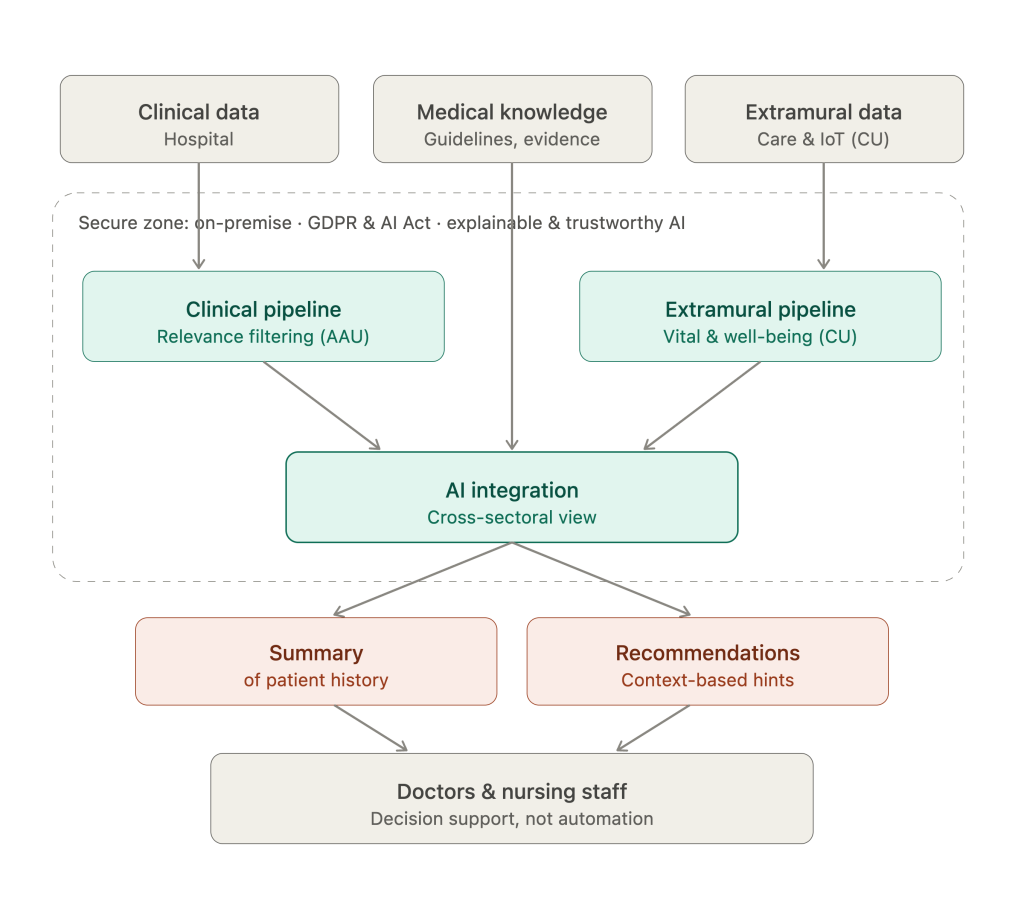
AutoGeri-Assist is of core importance in the contemporary healthcare landscape in Carinthia: geriatric care is becoming more demanding because patients often have multiple conditions, take several medications, and arrive with a growing amount of documentation. Important details can be hidden in long records, outdated reports, or incomplete information from different care settings. As a consequence, physicians and nursing staff in hospitals have to consolidate relevant information from distributed data sources under significant time pressure, burdened by the increasing amounts of geriatric patient data. The project will transfer scientific know-how and technological competence in the field of Artificial Intelligence into a real-world clinical application (within geriatrics), introducing innovation in the geriatric care in Carinthia. With the use of supportive AI systems, we aim to reduce documentation review effort, decrease workloads for clinical staff, and help clinicians to properly prepare individual decisions regarding therapy and care. Additionally, AI systems have the potential to evaluate extramural care, vital, and well-being data and merge them with clinical analyses into a cross-sector to further improve the quality of patient treatment. A great focus is made on keeping these AI systems only as a support to the hospital personal, and never as the deciding tool: through the structured preparation of historical clinical data, patterns and correlations in medication and nursing trajectories can be traced and made usable for future decisions without interfering with the clinical decision-making process. Beyond the hospital as the primary partner, the developed system architecture offers the perspective of expansion to other institutions in the regional healthcare and nursing sector, such as nursing homes, rehabilitation centers, or extramural care structures. This allows the know-how built up in the project to be made accessible to other relevant actors in the healthcare sector in the long term.
The project is designed as a clinical support tool, not as a replacement for medical judgment. It prepares information in a structured way so that healthcare professionals can make faster, better-informed decisions while keeping full responsibility for diagnosis, therapy, and care planning.
Technologies
The focus of AutoGeri-Assist is the use of generative Artificial Intelligence to create patient summaries, starting from their clinical history, prescriptions and the evolution of their cases. For this reason, it is fundamental that the technologies and designs behind this AI system are data-protection- and privacy-compliant. The usage of approaches like Knowledge Graphs and Retrieval Augmented Generation and state-of-the-art technologies ensure that the system prioritizes only the most relevant information, stemming from a multimodal set of sources (like exam reports, clinician notes and medical images) about the patient, filtering the data to automatically identify outdated and incomplete informationpro. AutoGeri-Assist will also monitor certified medical publications and guidelines, so that new application-oriented knowledge (for example changes in medication recommendations) is transferred into daily clinical practice in a targeted and contextual manner, supporting the continuous transfer of the latest findings from applied research into the practical, clinical care of geriatric patients.
Project Partners
The project brings together the University of Klagenfurt, Carinthia University of Applied Sciences, and a hospital-based geriatric care team.
This combination of research expertise, applied development, and clinical practice is central to the project. It ensures that the system is shaped by real-world needs and evaluated in a meaningful setting.